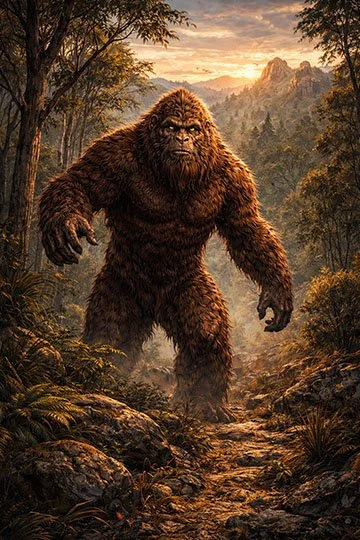
Pacific Northwest Sasquatch: The Heart of Bigfoot Legends, Sightings, and Cryptozoology
Where Bigfoot Became a Cultural Icon
When people hear the words Bigfoot or Sasquatch, the Pacific Northwest almost immediately comes to mind. Towering evergreen forests, misty mountain ranges, endless rainfall, and vast stretches of remote wilderness create an atmosphere that feels made for mystery. From Northern California through Oregon, Washington, and into British Columbia, the Pacific Northwest has become the global epicenter of Sasquatch legends, cryptid sightings, and modern cryptozoology.
Unlike other regions where Bigfoot remains a quiet folklore presence, the Pacific Northwest Sasquatch has become a cultural icon. It appears in documentaries, roadside attractions, forest signage, folklore blogs, cryptid culture communities, and countless eyewitness accounts. Yet despite decades of attention, research, and exploration, the mystery remains unresolved.
The Pacific Northwest offers a unique blend of ancient Indigenous folklore, modern wilderness encounters, and ongoing cryptid research. This region doesn’t just host Bigfoot sightings—it defines the modern understanding of Sasquatch behavior, habitat, and legend.
The Pacific Northwest Landscape: Built for Secrecy
The geography of the Pacific Northwest is one of the most compelling reasons it remains a Sasquatch hotspot. The region includes:
Dense temperate rainforests
Mountain ranges such as the Cascades and Coast Mountains
Volcanic terrain and lava tubes
Vast national forests and protected lands
Heavy rainfall and constant fog
These environments dramatically reduce visibility, suppress sound, and limit human access. Even experienced outdoors enthusiasts often underestimate how easily someone—or something—can remain hidden in these forests.
Remote forests and wilderness encounters are central to cryptid sightings here. The environment allows Sasquatch to move undetected while providing abundant food sources, shelter, and cover.
Indigenous Folklore and Sacred Stories
Long before Sasquatch became a modern cryptid, Indigenous tribes of the Pacific Northwest told stories of forest beings that closely resemble today’s Bigfoot descriptions. Tribes such as the Salish, Lummi, Makah, and Sts’ailes spoke of powerful beings known by names like Sásq’ets or Skookum.
These beings were often described as:
Tall and powerful
Covered in hair
Intelligent and aware
Capable of communication
Connected to sacred lands
In Indigenous folklore, Sasquatch was not a monster. It was often a spiritual being, sometimes dangerous but deserving of respect. Many stories framed these beings as guardians of nature or reminders of humanity’s place within the natural world.
This Indigenous context is critical. It suggests that Sasquatch legends are not recent inventions but ancient oral traditions rooted in ancestral knowledge and lived experience.
The Birth of Modern Sasquatch
The modern Sasquatch legend truly took shape in the Pacific Northwest during the 20th century. Newspaper reports of large footprints, strange encounters, and mysterious creatures began appearing throughout the region.
One of the most influential moments in cryptozoology history occurred in 1967 with the filming of what became known as the Patterson–Gimlin footage. Shot in Northern California, the film allegedly shows a large, bipedal, hair-covered creature walking across a creek bed.
Whether viewed as evidence or controversy, this footage cemented the Pacific Northwest as the heart of Bigfoot research and debate.
Sasquatch Sightings and Eyewitness Accounts
Pacific Northwest Sasquatch sightings are remarkably consistent. Eyewitness accounts frequently describe:
Large bipedal figures crossing forest roads
Broad shoulders and long arms
Dark brown or black hair
Smooth, powerful movement
A sense of intelligence or awareness
Many witnesses also report strange sounds, including deep vocalizations, wood knocking, and rhythmic howls. These sounds often occur at night or during low-visibility conditions such as fog or heavy rain.
Cryptid sightings in this region are so common that many locals treat them as part of life rather than something extraordinary.
Sasquatch Behavior in the PNW
Researchers who focus on Sasquatch behavior often look to Pacific Northwest encounters for patterns. Reported behaviors include:
Avoidance of human contact
Use of elevation and cover to observe
Nocturnal or crepuscular movement
Strategic retreat into dense vegetation
Silence when humans approach
These patterns suggest intelligence and adaptability rather than random animal behavior. Some cryptozoologists believe Sasquatch may possess a level of situational awareness that allows it to anticipate human movement.
Why the Pacific Northwest Produces So Much Evidence
A common question is why the Pacific Northwest produces so many sightings, footprints, and audio recordings—yet still no definitive proof.
Several explanations exist:
Environmental Complexity: Dense forests obscure clear views
Moist Conditions: Rain degrades physical evidence quickly
Vast Land Area: Large regions remain unexplored
Cultural Acceptance: Witnesses feel safer sharing experiences
Possible Avoidance Intelligence: Cryptids may actively avoid detection
These factors make the Pacific Northwest both evidence-rich and proof-poor.
Paranormal and Supernatural Theories
Not all Sasquatch encounters in the Pacific Northwest fit a purely biological explanation. Many witnesses report:
Sudden silence in the forest
Feelings of dread or being watched
Electronic interference
Objects thrown from unseen locations
Disappearances without sound
These experiences fuel paranormal theories suggesting Sasquatch may be a supernatural being, interdimensional entity, or manifestation of unseen forces. Some researchers connect Sasquatch encounters to broader unexplained phenomena such as UFO sightings or energy anomalies.
Cryptozoology Research in the PNW
The Pacific Northwest remains the most active region for cryptozoology research. Field investigators document footprints, collect audio recordings, and analyze eyewitness accounts.
While mainstream science remains skeptical, the sheer volume of consistent reports keeps Sasquatch firmly in cryptozoology discussions.
Sasquatch in Pacific Northwest Culture
Sasquatch has become woven into Pacific Northwest identity. Road signs warn of crossing Bigfoot. Towns host festivals. Local businesses embrace the legend. This isn’t commercialization—it’s cultural storytelling rooted in shared mystery.
Cryptid culture thrives here because the legend feels alive, not historical.
Why Sasquatch Endures in the PNW
The Pacific Northwest reminds us that wilderness still exists on a scale that defies total human control. Sasquatch legends persist because they symbolize that wildness—the idea that something ancient and intelligent may still exist beyond our reach.
The Forest Still Breathes
In the misty forests of the Pacific Northwest, the line between folklore and reality blurs. Sasquatch remains unseen, yet deeply felt. Whether biological, supernatural, or symbolic, the legend continues to walk beside us—just beyond the tree line.