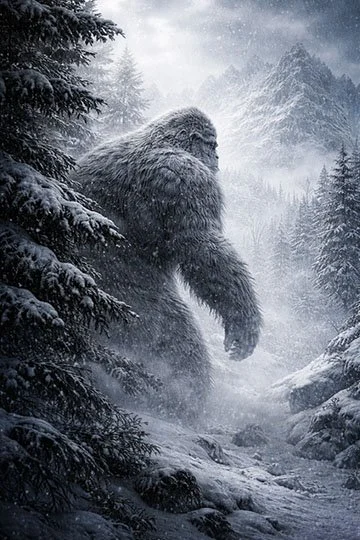
The Himalayan Yeti: Ancient Mountain Legends, Sacred Folklore, and the World’s Most Elusive Cryptid
The Shadow That Walks the Roof of the World
High above the forests and valleys of the world, where oxygen thins and the landscape becomes hostile to most forms of life, legends persist of a mysterious creature known as the Yeti. Often referred to as the Abominable Snowman, the Yeti occupies a unique place in global cryptozoology. Unlike Bigfoot of North America or Australia’s Yowie, the Yeti is inseparable from the harsh, sacred, and awe-inspiring environment of the Himalayan Mountains.
Spanning Nepal, Tibet, Bhutan, northern India, and parts of China, the Himalayas are home to some of the most remote and least explored terrain on Earth. These mountains are not only physically imposing—they are culturally and spiritually significant. For centuries, Indigenous communities, monks, and mountain dwellers have spoken of a powerful being that lives beyond the snowline, watching from glaciers, cliffs, and hidden valleys.
The Yeti legend is not a product of modern fascination with cryptids. It is an ancient story rooted in oral traditions, sacred beliefs, and firsthand encounters passed down for generations. Today, it continues to inspire explorers, cryptozoologists, and paranormal researchers alike.
The Himalayan Environment: A Realm Beyond Human Comfort
The Himalayas are one of the most extreme environments on the planet. Towering peaks, deep ravines, vast glaciers, and constant snowfall create conditions that are both deadly and isolating. Entire regions remain largely unexplored due to their inaccessibility.
Key environmental features include:
Extreme cold and rapidly changing weather
Steep terrain with limited access routes
Vast glacial systems and snowfields
Minimal permanent human habitation
Sparse wildlife adapted to high altitudes
These factors make the Himalayas an ideal location for a cryptid to remain hidden. Even modern expeditions struggle to survive in these conditions, let alone thoroughly explore every valley or ridge. If a large, intelligent creature were to exist here, the landscape itself would protect it.
Indigenous Folklore and Sacred Traditions
The Yeti is deeply embedded in Himalayan folklore, particularly among Sherpa communities, Tibetan monks, and Indigenous mountain tribes. Unlike Western portrayals that often sensationalize the creature, local traditions present the Yeti as a complex being—sometimes feared, sometimes respected, and often revered.
In many traditions, the Yeti is seen as:
A guardian of sacred lands
A spiritual being rather than a simple animal
A symbol of nature’s power and balance
A warning against arrogance or disrespect
Some Buddhist teachings describe the Yeti as a being that exists between worlds—neither fully physical nor entirely spiritual. This perspective shapes how encounters are interpreted, emphasizing humility and respect rather than fear.
Early Western Encounters and the Birth of the “Abominable Snowman”
Western awareness of the Yeti began in earnest during the early 20th century, when explorers and mountaineers reported strange footprints and sightings during Himalayan expeditions. One of the most famous incidents occurred in 1951, when mountaineer Eric Shipton photographed large footprints in the snow near Mount Everest.
These images sparked global fascination and introduced the term “Abominable Snowman” into popular culture. While the phrase was a mistranslation of local terminology, it permanently shaped Western perceptions of the Yeti.
Despite increased attention, local communities continued to view the Yeti through a spiritual and cultural lens rather than as a monster or curiosity.
Yeti Sightings and Eyewitness Accounts
Over the decades, numerous Yeti sightings have been reported by climbers, monks, herders, and villagers. These accounts are remarkably consistent across regions.
Common descriptions include:
Large, bipedal figures moving across snowfields
Dark or light-colored fur depending on region
Powerful legs adapted for mountainous terrain
Silent movement despite size
Avoidance of direct human interaction
Many witnesses report seeing the Yeti only briefly, often at a distance, before it disappears into the terrain. Some encounters include strange sounds or an overwhelming sense of presence.
Footprints, Hair Samples, and Physical Evidence
Physical evidence related to the Yeti has long been a subject of debate. Footprints discovered in snow are often large, elongated, and humanoid in shape. However, snow conditions can distort tracks, making definitive identification difficult.
Hair samples attributed to the Yeti have been analyzed multiple times. While some tests have identified known animals such as bears or goats, others remain inconclusive. This ambiguity fuels ongoing debate within cryptozoology.
The lack of definitive proof mirrors challenges faced in Bigfoot research worldwide, reinforcing the question: why is Bigfoot—or the Yeti—never found?
Behavioral Patterns of the Yeti
Reported Yeti behavior suggests a creature well adapted to its environment. Unlike forest-dwelling cryptids, the Yeti appears capable of surviving extreme cold and altitude.
Behavioral traits commonly reported include:
Seasonal movement following weather patterns
Use of high ground for observation
Avoidance of populated areas
Strategic movement through snow and rock
Limited vocalization
These patterns suggest intelligence, awareness, and long-term adaptation rather than random animal behavior.
Paranormal and Spiritual Interpretations
As with other cryptids, the Yeti is often associated with paranormal explanations. Some encounters include elements that defy conventional understanding, such as sudden silence, disorientation, or inexplicable fear.
Spiritual interpretations propose that the Yeti may be:
A guardian spirit of the mountains
An interdimensional being
A manifestation of ancient consciousness
A protector of sacred spaces
These interpretations align closely with Buddhist and Indigenous teachings, which emphasize coexistence rather than domination of nature.
Why the Yeti Remains Elusive
Several factors contribute to the Yeti’s enduring mystery:
Extreme Terrain: Few humans can survive long in its habitat
Limited Access: Entire regions remain unexplored
Cultural Respect: Locals often avoid disturbing sacred areas
Environmental Conditions: Snow obscures and destroys evidence
Possible Intelligence: Avoidance behavior may be intentional
Together, these factors make the Himalayas one of the most plausible regions for an undiscovered cryptid to exist.
The Yeti in Modern Cryptid Culture
While not as commercialized as Bigfoot, the Yeti holds a respected place in global cryptid culture. It is frequently discussed in cryptozoology blogs, folklore studies, and paranormal research circles.
Unlike novelty-driven portrayals, the Yeti is often approached with seriousness and reverence due to its cultural and spiritual significance.
Why the Yeti Legend Endures
The endurance of the Yeti legend speaks to humanity’s understanding that some places remain beyond full comprehension. The Himalayas represent nature at its most powerful and unforgiving—a realm where mystery feels not only possible but expected.
The Yeti embodies that mystery, standing as a reminder that not all questions have answers.
The Mountains Keep Their Watch
The Himalayan Yeti exists at the crossroads of folklore, spirituality, and unexplained phenomena. Whether it is a biological cryptid, a spiritual guardian, or something beyond current understanding, its presence in human storytelling remains powerful.
As long as the mountains stand and stories are passed down, the Yeti will continue to walk the snowbound edges of our imagination—silent, unseen, and enduring.