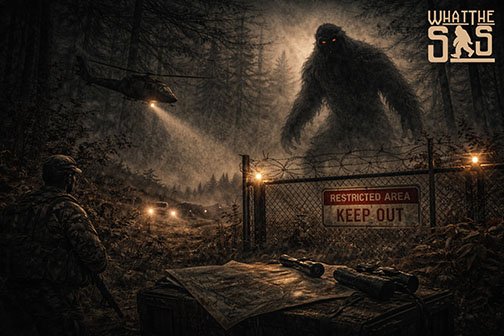
Does the Military Suppress Bigfoot Sightings?
For decades, Bigfoot sightings, Sasquatch encounters, and other cryptid sightings have followed a familiar pattern. A witness reports something unusual in a remote forest. Strange tracks appear. Wildlife behaves erratically. Then, sometimes, something else happens—restricted access, official presence, quiet warnings, or sudden silence.
Within cryptozoology, this recurring overlap between Bigfoot encounters and military or government activity has fueled one of the most persistent questions in cryptid culture: does the military play a role in suppressing or managing information about Bigfoot?
This question sits at the crossroads of paranormal research, urban legends, folklore, and modern institutional secrecy. It does not require belief in conspiracy to ask why reports involving mysterious creatures so often intersect with restricted land, federal jurisdiction, or official non-engagement.
This article explores the idea carefully—examining history, geography, policy, and psychology to understand whether the military’s role is one of deliberate cover-up, cautious containment, or coincidence shaped by perception.
Why Bigfoot Sightings Attract Official Attention
From a practical standpoint, any repeated reports of a large, unidentified creature raise concerns that extend beyond folklore. Governments and military institutions exist to manage unknowns—especially those involving public safety, environmental impact, or national security.
A hypothetical unknown primate species could involve:
• Human safety concerns
• Ecological disruption
• Disease transmission
• Cross-border implications
• Public panic
Even without proof, repeated reports demand assessment. Silence, in this context, may reflect uncertainty rather than denial.
The Geography of Secrecy and Sasquatch
One of the strongest patterns noted in Bigfoot research is geographic overlap. Many Sasquatch encounters occur near:
• Military training forests
• Federal land
• Restricted or semi-restricted zones
• Wilderness areas with limited civilian access
These locations are often preserved, undeveloped, and minimally populated—conditions that support both wildlife survival and military training.
To cryptid enthusiasts, this overlap feels intentional. To land managers, it is logistical.
But when sightings occur and access becomes suddenly restricted, curiosity hardens into suspicion.
Why Military Land Creates the Perfect Bigfoot Habitat
Military lands are among the least disturbed ecosystems in North America. While used for training, vast sections remain untouched for decades. These environments offer:
• Dense forest cover
• Limited human presence
• Protected wildlife corridors
• Reduced urban intrusion
If Bigfoot exists as a biological being, such areas would be ideal habitats. If Bigfoot exists as folklore, these same conditions also support long-lasting legends.
Either way, the land itself fuels the narrative.
Helicopters, Patrols, and Post-Sighting Activity
Many Bigfoot eyewitness accounts describe helicopters appearing shortly after encounters—often flying low, circling forested areas, or moving in patterns that suggest search activity.
From an official perspective, helicopters are used routinely for:
• Training exercises
• Fire surveillance
• Search and rescue
• Border monitoring
From a witness perspective, timing matters. When strange encounters are followed by sudden aircraft presence, the mind looks for connection.
The military may be responding to reports. Or witnesses may be interpreting routine activity through the lens of shock.
Information Control Is Not New
The idea that the military controls information is not speculative—it is historical fact. Throughout the 20th century, governments classified:
• Aircraft development
• Surveillance technology
• Weapons systems
• Biological research
Often, secrecy existed not to deceive the public indefinitely, but to prevent panic or protect incomplete research.
If Bigfoot sightings were ever taken seriously at an institutional level, silence would be consistent with precedent.
Bigfoot, Folklore, and Institutional Blind Spots
Many Native American legends describe forest beings that resemble modern Sasquatch descriptions. These stories were preserved through oral traditions long before modern military institutions existed.
When governments dismiss cryptid accounts outright, they often overlook this deeper historical context. What is framed as myth may represent a form of ecological knowledge that does not fit modern classification systems.
This creates a tension between ancestral knowledge and institutional authority.
Are Cryptids a National Security Issue?
From a purely theoretical standpoint, an unknown large species raises legitimate questions:
• Does it migrate across borders?
• Does it interact with civilians?
• Could it cause harm?
• Could it be misidentified military activity?
The military may investigate not because Bigfoot exists—but because uncertainty does.
In this sense, involvement does not equal belief.
Why the “Cover-Up” Narrative Persists
Despite lack of concrete proof, the idea of a cover-up persists because of repeated experiences that feel similar across time and geography:
• Sightings followed by official presence
• Witnesses discouraged from speaking
• Locations quietly restricted
• Evidence disappearing or dismissed
Patterns alone do not prove intent—but they invite scrutiny.
Psychological Factors and Perception
Encounters with mysterious creatures are often emotionally intense. Fear, awe, and confusion can alter memory and perception. When authority figures appear afterward, the mind naturally seeks meaning.
In some cases, what feels like suppression may simply be procedure.
In others, silence amplifies uncertainty.
Skeptical Perspectives
Skeptics argue that:
• Military land is common in rural areas
• Helicopters are not unusual
• Restricted access is standard protocol
• Eyewitness memory is unreliable under stress
These explanations account for many reports—but not all. The persistence of similar stories keeps the question alive.
Cryptids, Control, and Public Narrative
Governments manage narratives as much as they manage land. Admitting uncertainty can undermine public confidence. Dismissing reports outright avoids difficult conversations.
Between these two responses lies a gray space where cryptids thrive.
Bigfoot and the Fear of the Unknown
Perhaps the military’s role—real or perceived—is less about Bigfoot itself and more about what Bigfoot represents. A reminder that not everything in the wilderness is cataloged. That nature still holds unknowns.
Institutions built on control struggle with that idea.
Why There Is No Proof of a Cover-Up
Despite decades of speculation, there is no verified documentation confirming an organized military effort to conceal Bigfoot’s existence. No leaked files. No official admissions.
This absence matters.
It suggests that if involvement exists, it is likely fragmented, localized, or driven by caution rather than conspiracy.
The Difference Between Suppression and Non-Engagement
Silence is not always suppression. Sometimes it is refusal to validate claims that cannot be confirmed.
For witnesses, this feels dismissive. For institutions, it feels responsible.
The gap between those perspectives fuels cryptid culture.
Why Bigfoot Remains a Borderline Subject
Bigfoot sits at the edge of multiple disciplines:
• Biology
• Anthropology
• Folklore
• Paranormal research
• Environmental science
Anything that exists between categories is difficult to acknowledge officially.
The military, like science, prefers clear definitions.
What Patterns Actually Suggest
The most reasonable interpretation is not that the military is hiding Bigfoot—but that unexplained phenomena intersect with systems designed to manage uncertainty.
That overlap feels intentional, even when it may not be.
Cover-Up or Caution?
So, is the military covering up Bigfoot?
There is no definitive proof. But there is a long history of silence, overlap, and unanswered questions.
What exists instead is a pattern of caution—of institutions choosing not to engage publicly with phenomena that resist classification.
Bigfoot remains unconfirmed not because of a single secret—but because acknowledging uncertainty is harder than denying it.
And in the quiet spaces between wilderness and authority, cryptids continue to walk.