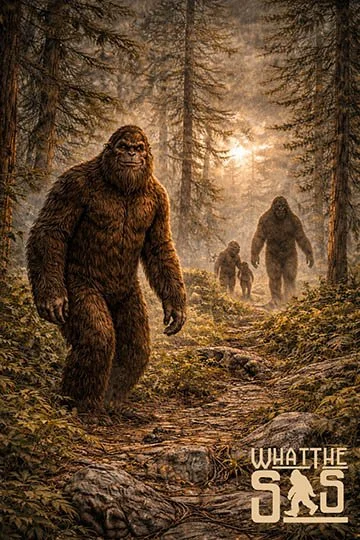
Is Sasquatch a Solitary Creature or a Social Species?
One of the Biggest Questions in Bigfoot Research
Among all the mysteries surrounding Bigfoot, Sasquatch, and cryptids, one question continues to spark debate in the world of cryptozoology:
Is Sasquatch alone… or are there more?
For decades, Bigfoot sightings, Sasquatch encounters, and eyewitness reports have painted two very different pictures. Some describe a lone, elusive giant moving silently through the forest. Others report multiple creatures, family groups, or even coordinated behavior.
So which is it?
Is Sasquatch a solitary creature, like a mountain lion…
Or a social species, like primates—including humans?
To answer that, we need to look at patterns in sightings, behavior, habitat, and the growing body of Sasquatch research.
Understanding the Solitary Creature Theory
Many Bigfoot researchers believe Sasquatch is primarily solitary.
Why This Theory Exists
Most Bigfoot sightings involve:
A single creature
Brief encounters
No visible companions
This has led to the idea that Sasquatch behaves like:
Bears
Mountain lions
Other large, territorial mammals
These animals typically:
Live alone
Avoid others except during mating
Maintain large territories
Evidence Supporting Solitary Behavior
Single Visual Encounters
The vast majority of Bigfoot sightings describe one individual.Wide Geographic Distribution
Sasquatch sightings occur across North America, suggesting large territories per individual.Low Population Density
If Sasquatch exists, it would likely need space and resources—supporting solitary living.
The Case for Sasquatch as a Social Species
Now here’s where things get interesting…
Not all reports describe a lone creature.
Multiple Witness Accounts
Some Sasquatch encounters include:
Two or more figures moving together
Smaller figures alongside larger ones
Sounds coming from multiple directions
These reports suggest possible:
Family units
Group communication
Coordinated movement
Juvenile Sightings
Witnesses occasionally report:
Smaller Bigfoot figures
Young creatures following adults
This is one of the strongest arguments for social structure.
If juveniles exist, they must be:
Raised
Protected
Taught survival behaviors
That implies family groups, not isolation.
Comparing Sasquatch to Known Primate Behavior
If Sasquatch is a primate—as many cryptozoologists suggest—then its behavior may resemble:
Gorillas
Chimpanzees
Orangutans
Gorillas (Social)
Live in groups
Led by dominant individuals
Strong family bonds
Chimpanzees (Highly Social)
Complex communication
Cooperative behavior
Group hierarchy
Orangutans (Semi-Solitary)
Mostly solitary
Occasional social interaction
Strong mother-offspring bond
👉 Many researchers believe Sasquatch may fall somewhere between gorillas and orangutans.
Behavioral Clues from Sasquatch Sightings
Let’s look at recurring patterns in Bigfoot encounters.
1. Vocalizations
Reports often include:
Whoops
Howls
Wood knocks
These sounds sometimes:
Come from multiple directions
Seem responsive or conversational
This suggests possible communication between individuals.
2. Tree Structures and Markers
Some researchers report:
Bent trees
Stacked branches
Unusual formations
Theories suggest these could be:
Territorial markers
Communication signals
Gathering points
If true, this points toward organized behavior—not isolation.
3. Coordinated Movement
Certain eyewitness accounts describe:
One creature distracting while another moves
Sounds used to guide or warn
This kind of behavior would indicate group awareness.
Why We Might Only See One Sasquatch
Even if Sasquatch is social, we usually only see one.
Why?
Possibility #1: Protective Behavior
One individual may:
Reveal itself briefly
Draw attention away from others
Especially if:
Young are nearby
The group feels threatened
Possibility #2: Exceptional Stealth
Sasquatch is often described as:
Silent
Fast
Highly aware of surroundings
It’s possible:
We’re only seeing the one that wants to be seen.
Possibility #3: Low Population Density
Even social species can:
Spread out over large areas
Avoid clustering
So sightings may still appear solitary.
Indigenous Perspectives on Sasquatch Behavior
Long before modern Bigfoot research, Indigenous cultures across North America described similar beings.
Many traditions include:
Family groups
Tribal structures
Intelligent, social behavior
These stories often portray Sasquatch as:
A people of the forest
A hidden society
Observers of humans
This aligns more closely with the social species theory.
Environmental Factors: Survival and Social Structure
If Sasquatch exists, its environment would shape its behavior.
Pacific Northwest Conditions
Dense forests
Abundant food sources
Limited human interference
These conditions could support:
Small family groups
Seasonal movement patterns
Appalachian and Southern Regions
Thicker undergrowth
Warmer climates
Different prey availability
This could influence:
Territory size
Group interaction frequency
The Hybrid Theory: Solitary… But Not Alone
Many researchers now believe the answer isn’t one or the other.
Instead:
Sasquatch may be semi-solitary
Meaning:
Individuals travel alone frequently
But remain part of a larger group or territory
Come together for mating, raising young, or communication
This model fits:
Sightings
Behavior patterns
Primate comparisons
What This Means for Bigfoot Trackers
Understanding whether Sasquatch is solitary or social changes everything for tracking.
If Solitary:
Focus on large territories
Track individual movement patterns
If Social:
Look for multiple signs in one area
Pay attention to sound patterns
Watch for coordinated behavior
The Role of Modern Cryptozoology
Today, cryptozoology continues to explore this mystery through:
Audio analysis
Footprint tracking
Environmental study
Eyewitness documentation
The goal isn’t just to prove Bigfoot exists…
It’s to understand how it lives.
Why This Mystery Still Matters
Whether Sasquatch is solitary or social, one thing is clear:
The mystery keeps growing.
Bigfoot represents:
The unknown
The unexplained
The possibility that something still exists beyond our understanding
In a world where so much has been discovered, the idea of a hidden species—living quietly in the forests—captures our imagination like nothing else.
Alone… Or Part of Something Bigger?
So—is Sasquatch a solitary creature or a social species?
The answer may be:
Both.
A creature that moves alone…
But belongs to something more.
A being that avoids humans…
But may not be alone in the forest.
And maybe, just maybe…
When you think you’re alone in the woods…
You’re not.