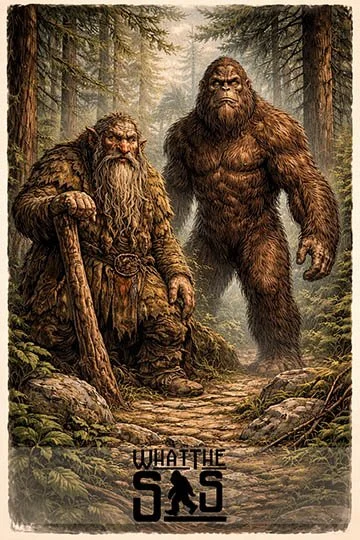
Norse Trolls and Pacific Northwest Sasquatch: Any Connection?
Two Legends, One Mystery
Across continents and centuries, stories of mysterious creatures have persisted in human culture. From the dense, mist-covered forests of Scandinavia to the towering evergreen wilderness of the Pacific Northwest, legends of massive, elusive beings have fascinated generations. In Norse folklore, these beings are known as trolls—ancient, powerful creatures tied to the land itself. In North America, a similar figure emerges in the form of Bigfoot, also known as Sasquatch.
At first glance, these two legendary creatures may seem like products of entirely different worlds—one rooted in ancient European mythology, the other in modern cryptozoology and eyewitness accounts. But when we begin to look closer, the similarities between Norse trolls and Pacific Northwest Sasquatch become increasingly intriguing.
Are these just parallel myths shaped by similar environments? Or could there be a deeper connection between these mysterious creatures that spans continents, cultures, and time?
Let’s step into the forests—both ancient and modern—and explore the possibility that these legends may not be as separate as they seem.
The Norse Troll: Guardians of Myth and Wilderness
In Norse mythology, trolls are among the most iconic mythical creatures. They are often described as large, powerful beings that dwell in remote mountains, caves, and deep forests. Unlike the more refined gods of Asgard, trolls are closely tied to the raw, untamed forces of nature.
Physical Description and Behavior
Trolls vary widely in appearance depending on the saga or region, but several common traits emerge:
Massive, towering size
Thick, rugged features—sometimes almost human, sometimes grotesque
Hair-covered or moss-covered bodies blending into their surroundings
Incredible strength
A tendency to avoid human contact
Many stories describe trolls as nocturnal beings who turn to stone when exposed to sunlight—a fascinating trait that may symbolize their deep connection to darkness and wilderness.
Trolls as Nature Spirits
In Scandinavian folklore, trolls are often seen as guardians of the wild. They inhabit places humans fear or avoid—dense forests, jagged mountains, and isolated valleys. These environments mirror the habitats often associated with Sasquatch sightings in North America.
Trolls are not merely monsters; they are part of the ecosystem of myth. They represent the unknown, the unexplained, and the powerful forces beyond human control.
Sasquatch of the Pacific Northwest: A Modern Cryptid
In contrast to trolls, Sasquatch exists in a unique space between folklore and alleged reality. While Bigfoot is often categorized as a cryptid—a creature whose existence is debated but unproven—it is supported by thousands of eyewitness accounts, footprint evidence, and ongoing research.
The Sasquatch Profile
Descriptions of Sasquatch are surprisingly consistent across regions:
Height ranging from 6 to 10 feet
Covered in dark brown or black hair
Broad shoulders and a muscular build
Human-like face with pronounced brow ridge
Strong, deliberate movements
Unlike trolls, Sasquatch is rarely described as aggressive. Most encounters suggest a shy, elusive creature that avoids human interaction whenever possible.
Geographic Hotspots
The Pacific Northwest—covering Washington, Oregon, Northern California, and parts of British Columbia—is considered the epicenter of Sasquatch sightings. These regions are characterized by:
Dense, old-growth forests
Mountainous terrain
Limited human access
Abundant wildlife
These environmental factors closely resemble the habitats associated with Norse trolls.
Shared Characteristics: Trolls and Sasquatch
When we compare Norse trolls and Sasquatch side by side, several striking similarities emerge.
1. Habitat: Remote Wilderness
Both creatures are said to inhabit areas that are:
Deeply forested
Rugged and mountainous
Difficult for humans to access
These environments naturally lend themselves to mystery and unexplained phenomena, making them ideal settings for cryptid sightings and folklore.
2. Elusiveness and Avoidance of Humans
Trolls and Sasquatch are rarely seen. In both traditions:
Encounters are brief and often unclear
Creatures disappear quickly into the forest
Evidence is often indirect (tracks, sounds, broken branches)
This elusiveness is a cornerstone of both legends.
3. Physical Similarities
While trolls can vary widely in appearance, many descriptions align with Sasquatch characteristics:
Large, humanoid shape
Hairy or rugged exterior
Powerful build
Deep-set eyes and pronounced features
Some Scandinavian depictions of trolls even resemble what modern witnesses describe as Bigfoot.
4. Connection to Nature
Both creatures are deeply tied to their environments:
Trolls are seen as part of the natural world
Sasquatch is often described as highly intelligent and aware of its surroundings
In both cases, these beings seem to exist in harmony with nature rather than dominating it.
The Role of Folklore and Oral Tradition
One of the most fascinating aspects of this comparison lies in how stories evolve over time.
Norse Oral Traditions
Before written records, Norse myths were passed down through generations via storytelling. These tales often served as:
Explanations for natural phenomena
Warnings about venturing into dangerous areas
Cultural reflections of fear and respect for the wilderness
Native American Legends of Sasquatch
Long before modern Bigfoot sightings, Indigenous cultures across North America told stories of large, hairy beings inhabiting the forests. These beings were often:
Spiritual or supernatural
Guardians of the land
Both feared and respected
These traditions predate European contact, suggesting that Sasquatch-like legends are deeply rooted in the continent’s history.
Could Norse Explorers Have Influenced Sasquatch Legends?
One theory suggests that Norse explorers—such as the Vikings who reached North America around 1000 AD—may have brought their stories of trolls with them.
The Viking Connection
Norse settlements in Newfoundland are well-documented. It’s possible that:
Norse explorers encountered unfamiliar wildlife or Indigenous stories
They interpreted these through their own cultural lens—trolls
Over time, these ideas blended with local legends
However, this theory is debated, as Native American stories of Sasquatch-like beings existed long before Viking arrival.
Cryptozoology and the Search for Answers
In modern times, the study of cryptids—known as cryptozoology—has brought renewed attention to Sasquatch.
Researchers and enthusiasts investigate:
Footprint casts
Audio recordings
Eyewitness testimonies
Environmental patterns
While trolls are largely considered mythological, Sasquatch remains a subject of ongoing investigation.
Psychological and Cultural Explanations
Another perspective suggests that these creatures are products of human psychology.
Why Do These Legends Persist?
Humans are drawn to mystery and the unknown
Wilderness environments trigger primal instincts
Stories help explain unexplained experiences
Both trolls and Sasquatch may represent a universal human tendency to personify the unknown.
Environmental Influence on Myth Creation
The environments in which these legends arise play a crucial role.
Scandinavia vs. Pacific Northwest
Despite being continents apart, both regions share:
Dense forests
Misty, low-visibility conditions
Rugged terrain
These similarities may naturally lead to the creation of similar mythical creatures.
Eyewitness Accounts: Then and Now
Modern Sasquatch sightings often mirror ancient troll encounters:
Sudden appearance
Silent movement
Intense emotional reaction from witnesses
This overlap raises an interesting question—are we experiencing the same phenomenon under different names?
Are Trolls and Sasquatch the Same Phenomenon?
There are several possible explanations:
1. Cultural Interpretation of a Real Creature
A single unknown species interpreted differently across cultures.
2. Independent Myth Creation
Separate cultures creating similar legends due to similar environments.
3. Psychological Archetypes
A shared human archetype—the “wild man”—appearing globally.
Modern Fascination with Cryptids
Today, interest in Bigfoot, Sasquatch, and cryptids continues to grow.
From documentaries to podcasts, from eyewitness accounts to scientific debates, the mystery remains alive.
This enduring fascination reflects something deeper—our desire to believe that there is still something undiscovered in the world.
The Mystery Lives On
Whether Norse trolls and Pacific Northwest Sasquatch are connected through ancient migration, shared environments, or universal human storytelling, one thing is certain:
The legend of the unknown endures.
These mysterious creatures—whether myth, reality, or something in between, remind us that the world still holds secrets. In a time when so much has been mapped and explained, the idea that something large, intelligent, and unseen could still exist just beyond the edge of our understanding is both thrilling and humbling.
And maybe that’s why these stories never fade.