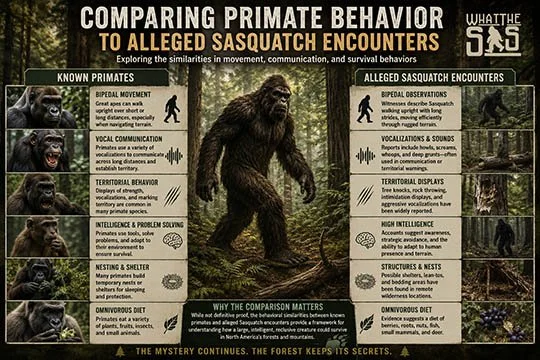
Comparing Primate Behavior to Alleged Sasquatch Encounters
Looking at Bigfoot Through a Primate Lens
Bigfoot has long existed in the space between folklore, cryptozoology, wilderness mystery, and unexplained phenomena. Across North America, thousands of alleged Sasquatch encounters describe a towering, hairy, human-like creature moving silently through forests, mountains, swamps, and remote wilderness. Witnesses report strange vocalizations, tree knocks, territorial behavior, unusual movement patterns, and fleeting glimpses of something that seems both human and animal at the same time.
For decades, discussions about Bigfoot have often focused on evidence:
footprints
hair samples
blurry photos
eyewitness accounts
vocal recordings
environmental anomalies
But another fascinating approach exists:
What happens if we compare alleged Sasquatch behavior to known primate behavior?
That question matters because many Bigfoot theories suggest Sasquatch could be:
an undiscovered primate
a relic hominid
an isolated branch of ancient human evolution
a surviving ape species adapted to North American wilderness
If that is true—or even remotely possible—then primate behavior becomes incredibly important.
And what’s fascinating is this:
Many alleged Bigfoot encounters describe behaviors remarkably similar to gorillas, chimpanzees, orangutans, and even early human survival patterns.
Now, this does not prove Bigfoot exists.
But it does create an interesting framework for understanding why so many Sasquatch sightings feel biologically believable to witnesses.
Let’s explore the similarities between known primate behavior and alleged Sasquatch encounters—and why the comparison continues to intrigue researchers, wildlife experts, and cryptozoology enthusiasts alike.
Why Primate Behavior Matters in Bigfoot Research
Primates are among the most intelligent and adaptable mammals on Earth.
They display:
social structures
communication systems
tool use
territorial behavior
emotional intelligence
stealth movement
problem solving
environmental adaptation
If Sasquatch exists as a biological creature, it would almost certainly require advanced intelligence to remain hidden across modern North America.
That immediately pushes researchers toward primate comparisons.
Why?
Because primates excel at:
avoiding threats
navigating dense environments
adapting to terrain
communicating quietly
remaining elusive when necessary
Many alleged Bigfoot encounters involve exactly those traits.
Upright Walking and Bipedal Movement
Perhaps the most obvious comparison is bipedal movement.
Bigfoot sightings almost always describe:
upright walking
long strides
human-like posture
fluid movement through rough terrain
Among primates, humans are fully bipedal, but other primates—including chimpanzees and gorillas—can also walk upright for short distances.
Witnesses often describe Sasquatch movement as:
smoother than a bear
more natural than a human in rough terrain
unusually efficient
surprisingly quiet for such a large creature
That combination resembles how highly adapted primates move within familiar environments.
Vocalizations: Communication Through Sound
One of the most fascinating parallels involves vocal behavior.
Alleged Sasquatch encounters often include:
screams
howls
whistles
growls
knocking sounds
rhythmic calls
Primates are highly vocal creatures.
Chimpanzees use:
pant-hoots
screams
warning calls
territorial vocalizations
Gorillas communicate with:
grunts
roars
chest-beating displays
Orangutans produce:
long-distance calls
environmental communication sounds
Some Bigfoot researchers suggest tree knocks and unusual forest vocalizations may function similarly:
territorial signaling
group coordination
warning systems
distance communication
Again, this is speculative—but the behavioral similarity is interesting.
Territorial Behavior
Many alleged Sasquatch sightings involve territorial patterns.
Witnesses report:
rocks thrown nearby
aggressive vocalizations
bluff charges
wood knocks
intimidation displays
feeling “pushed out” of an area
Known primates display similar territorial behavior.
Gorillas use intimidation to avoid physical conflict.
Chimpanzees aggressively defend territory.
Many primates prefer warning displays over direct confrontation.
That behavioral overlap is notable because many Bigfoot encounters stop short of outright attack.
Instead, the creature allegedly attempts to:
scare
warn
intimidate
create distance
That is highly primate-like behavior.
Intelligence and Avoidance of Humans
One of the biggest arguments against Bigfoot is:
“How could a giant creature stay hidden?”
But primate intelligence changes the equation dramatically.
Great apes are extraordinarily intelligent.
They:
learn patterns quickly
avoid threats
recognize danger
change routines
adapt behavior based on experience
If Sasquatch possessed comparable intelligence, avoiding humans would become much more plausible.
Many alleged encounters suggest Sasquatch:
avoids roads
travels at night
watches humans from cover
retreats quickly when detected
uses terrain strategically
That sounds less like random animal behavior and more like advanced environmental awareness.
Nesting and Shelter Behavior
Some Bigfoot researchers claim to have discovered:
stick structures
bedding areas
woven branches
nest-like formations
This comparison becomes especially interesting because great apes create nests regularly.
Chimpanzees and gorillas build sleeping nests from vegetation.
Orangutans create elaborate tree nests daily.
If Sasquatch were a primate species, temporary wilderness structures would make biological sense.
Of course, natural explanations often exist for forest structures—but the similarity remains part of ongoing cryptozoology discussion.
Food Behavior and Omnivorous Diets
Alleged Sasquatch encounters suggest an omnivorous diet including:
berries
roots
fish
deer
small mammals
nuts
vegetation
This closely mirrors many large primates.
Primates are opportunistic feeders.
They adapt based on:
season
food availability
environment
competition
A large omnivorous primate in North America would likely behave similarly.
Emotional Intelligence and Curiosity
Some witnesses describe Sasquatch as:
curious
observant
cautious
emotionally expressive
aware of human presence
Primates possess remarkable emotional complexity.
They demonstrate:
curiosity
grief
fear
affection
strategic thinking
social awareness
This emotional realism may explain why many Bigfoot encounters feel deeply personal to witnesses.
People often report:
“It looked at me like it understood.”
“It seemed intelligent.”
“It felt human somehow.”
That reaction aligns strongly with primate psychology.
Stealth and Silence
One of the strangest details in Sasquatch sightings is silence.
Witnesses often report that despite immense size, the creature moves:
quietly
efficiently
almost invisibly through forest terrain
Primates are capable of remarkable stealth in familiar environments.
Despite their size, gorillas and chimpanzees can move surprisingly quietly through dense vegetation.
An intelligent wilderness-adapted primate would likely prioritize stealth as survival behavior.
Social Structure: Solitary or Group Species?
This is one of the biggest mysteries.
Bigfoot sightings vary dramatically:
Some describe solitary individuals.
Others describe family groups.
Primates display diverse social systems:
gorillas live in groups
orangutans are more solitary
chimpanzees have fluid social structures
If Sasquatch exists, its social behavior could vary similarly depending on habitat, season, food availability, and reproduction.
Why the Comparison Fascinates Researchers
The reason primate comparisons matter is simple:
They make alleged Sasquatch behavior feel biologically coherent.
Instead of imagining a movie monster, researchers begin asking:
How would a large intelligent primate behave?
How would it survive?
How would it avoid humans?
What communication methods would it use?
What habitat would it require?
Those are meaningful scientific questions—even if answers remain uncertain.
Skepticism Still Matters
Of course, none of these behavioral parallels prove Bigfoot exists.
That’s important.
Similar behavior could result from:
human interpretation
folklore influence
wildlife misidentification
psychological expectation
coincidence
Science still lacks definitive biological evidence for Sasquatch.
But behavioral analysis helps elevate the conversation beyond simple myth.
The Intersection of Science and Mystery
This is where Bigfoot becomes truly fascinating.
The mystery survives not because of proof—
but because certain patterns continue appearing.
And some of those patterns resemble known primate behavior in surprisingly consistent ways.
That overlap keeps curiosity alive.
Why the Question Endures
Comparing primate behavior to alleged Sasquatch encounters does not solve the Bigfoot mystery.
But it does make the mystery more interesting.
Because the more witnesses describe:
intelligence
stealth
communication
territoriality
emotional awareness
primate-like movement
…the harder it becomes to dismiss the conversation entirely.
Maybe Bigfoot is folklore.
Maybe Sasquatch is cultural mythology.
Maybe cryptozoology is chasing shadows.
Or maybe…
deep in forests vast enough to still hide secrets…
something intelligent has always been watching from the trees.