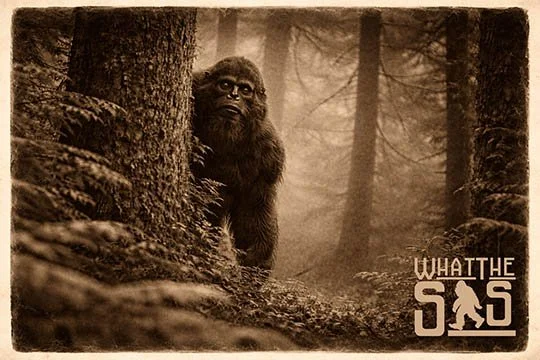
What the Sasquatch? Decoding Regional Bigfoot Myths Across the U.S.
One Legend, Many Faces
Bigfoot. Sasquatch. Skunk Ape. Grassman.
Across the United States, the legend of a large, mysterious, hair covered creature appears again and again. But what makes this phenomenon so fascinating is not just its persistence. It is how much it changes depending on where you are.
From the towering forests of the Pacific Northwest to the humid swamps of Florida, Bigfoot sightings take on regional personalities shaped by environment, folklore, and culture. These are not just stories. They are patterns. They are clues.
And they may hold the key to understanding one of the greatest mysteries in cryptozoology.
So what exactly is going on?
Let’s decode the regional Bigfoot myths across the United States.
Why Regional Bigfoot Myths Matter
More Than Just Stories
Regional variations in Bigfoot sightings are not random. They reflect:
Environmental differences
Cultural influences
Historical folklore
Human perception
In cryptozoology, these variations help researchers identify patterns in Sasquatch behavior, habitat, and reported encounters.
If Bigfoot exists as a biological creature, these differences may point to adaptation.
If Bigfoot is something more, these myths may reveal how humans interpret unexplained phenomena.
The Pacific Northwest Sasquatch
The Classic Bigfoot
When people think of Bigfoot, they are usually imagining the Pacific Northwest version.
This region includes:
Washington
Oregon
Northern California
Characteristics
Very large, often over eight feet tall
Dark brown or black hair
Massive build
Quiet movement
Behavior
Avoids humans
Observes from a distance
Leaves large footprints
Uses forest cover effectively
The dense forests of this region provide the perfect habitat for a large, elusive creature.
Appalachian Bigfoot
The Watcher in the Woods
The Appalachian Mountains have their own long history of Bigfoot sightings and wilderness legends.
Traits
Slightly smaller but still large
Dark or reddish hair
More vocal than other regions
Reports of glowing eyes
Behavior
More frequent encounters near humans
Loud vocalizations and wood knocks
Territorial behavior
Many witnesses describe a feeling of being watched, adding a paranormal element to these sightings.
The Florida Skunk Ape
Swamp Dwelling Mystery
In Florida, Bigfoot takes on a very different form.
Features
Leaner build
Reddish or dark hair
Extremely strong odor
Behavior
Moves through water and wetlands
Active in humid environments
Often detected by smell before sight
The Everglades provide a unique environment that shapes this version of the legend.
The Ohio Grassman
The Midwest Cryptid
In Ohio and surrounding areas, the Grassman is another variation of Bigfoot.
Traits
Large and muscular
Known for building nests or structures
Behavior
Throws objects
Seen near farmland and forests
Displays intelligence
This version adds a new layer to Bigfoot behavior.
Texas Bigfoot
Heat Adapted Sasquatch
In Texas, sightings often describe:
Taller, leaner figures
Faster movement
Adaptation to hotter climates
This suggests a creature capable of surviving in diverse environments.
Cultural Influences on Bigfoot Myths
Folklore and Storytelling
Regional myths are shaped by local culture and history.
Indigenous folklore often includes:
Hair covered beings
Spirit guardians
Creatures connected to nature
These stories predate modern Bigfoot research and provide valuable context.
Environmental Factors
How Geography Shapes the Legend
Different environments influence how Bigfoot is described.
Examples:
Dense forests lead to stealth and camouflage
Swamps encourage water based movement
Mountains require endurance and strength
These factors may explain regional differences.
Eyewitness Accounts Across Regions
Despite variations, many Bigfoot sightings share common elements:
Large, bipedal figure
Hair covered body
Sudden disappearance
Strong presence
These similarities suggest a shared phenomenon.
Biological vs Paranormal Interpretations
Regional myths also influence how Bigfoot is interpreted.
Some see:
A biological creature adapting to environments
Others believe:
A paranormal being appearing differently based on location
This divide adds complexity to the mystery.
The Role of Modern Technology
Technology has changed how Bigfoot sightings are documented.
Tools include:
Trail cameras
Thermal imaging
GPS tracking
However, AI and deepfakes also make it harder to verify evidence.
Why These Myths Endure
Bigfoot myths persist because they connect to something deeper.
They represent:
The unknown
The wild
The possibility of undiscovered creatures
Regional variations keep the story fresh and evolving.
A Mystery That Adapts
The question is not just whether Bigfoot exists.
It is why the story changes.
Each region adds its own layer to the legend, creating a complex and evolving mystery.
Whether Bigfoot is a real creature, a collection of myths, or something in between, one thing is clear.
The story is far from over.