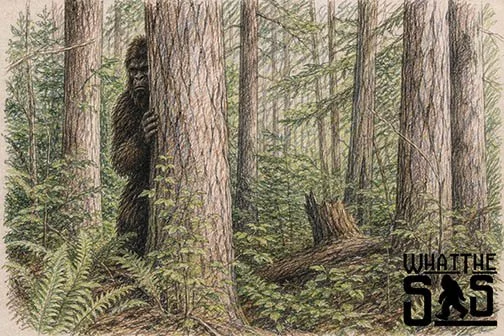
The Role of Trees in Sasquatch Camouflage
The Forest Does More Than Hide
When people imagine Bigfoot or Sasquatch, they often picture a massive hairy figure moving silently between towering trees deep in the wilderness. The image feels natural because forests and Sasquatch legends seem permanently connected. Bigfoot sightings almost always happen in places where trees dominate the landscape:
dense Pacific Northwest forests
Appalachian mountain woods
Canadian wilderness
swamp forests in the South
remote pine ridges
old growth timberland
But trees may do far more than simply provide habitat.
Many Bigfoot researchers, wilderness experts, trackers, hunters, and eyewitnesses believe forests themselves may act as one of Sasquatch’s greatest tools for survival and concealment.
The forest does not merely hide a creature.
The forest transforms visibility itself.
That idea becomes incredibly important when discussing cryptozoology, mysterious creatures, unexplained wilderness encounters, and the enduring mystery of Sasquatch camouflage.
Because when people ask:
“How could a giant creature remain hidden?”
They often underestimate how effectively forests distort perception.
Trees create shadows.
Trees break outlines.
Trees alter depth perception.
Trees absorb sound.
Trees create movement confusion.
And if an intelligent creature understands forests deeply enough, trees become more than cover.
They become camouflage.
Let’s explore how forests and tree environments may play a critical role in alleged Sasquatch concealment and why so many Bigfoot sightings happen in places where seeing clearly is nearly impossible.
Forests Are Designed to Break Visibility
Human vision works best in open spaces.
We evolved to recognize shapes, movement, and faces in environments where visibility is relatively clear.
Forests disrupt those strengths constantly.
Dense woods create:
vertical visual clutter
irregular shadows
shifting light patterns
layered depth confusion
obstructed sightlines
constant movement from leaves and branches
This matters because camouflage is not only about color.
Camouflage is about breaking recognition.
A large figure standing beside trees may visually disappear because the eye struggles to separate:
shadow from shape
bark texture from fur texture
movement from background motion
This effect becomes even stronger during:
dusk
fog
rain
snowfall
low light conditions
heavily wooded terrain
Many Sasquatch sightings occur in exactly those conditions.
Natural Coloring and Woodland Blending
Witnesses commonly describe Sasquatch as having:
dark brown fur
reddish brown fur
black hair
gray coloration
earth toned appearance
Those colors match forest environments perfectly.
Tree bark.
Wet wood.
Forest shadow.
Dead leaves.
Dark soil.
Pine trunks.
Burned timber.
At a distance, dark fur beside trees becomes extremely difficult to separate visually from surrounding terrain.
This is especially true in conifer forests where shadows naturally create large dark vertical shapes.
An intelligent creature would benefit enormously from coloration that blends into woodland texture.
Many predators and prey species already rely on this principle.
Big cats blend into grasslands.
Owls disappear into bark.
Deer freeze beside brush.
If Sasquatch exists as a biological species, forest coloration would be one of its greatest survival adaptations.
The Human Eye Misses Motion in Forests
One of the strangest things about forests is how easily large objects disappear.
Hunters experience this constantly.
A deer can stand motionless twenty yards away and remain invisible.
A black bear can vanish into shadows astonishingly quickly.
Even humans in camouflage become difficult to track visually in dense woods.
Now imagine:
a large creature adapted to forests
highly intelligent movement
dark natural coloring
instinctive understanding of terrain
deliberate use of trees for concealment
Suddenly Sasquatch camouflage becomes much more plausible.
Many alleged Bigfoot encounters involve only partial visibility:
glimpses between trees
shadow movement
shoulder or head visibility
figures partially obscured by trunks
brief movement before disappearance
This may not be accidental.
Trees naturally fragment visibility.
Tree Positioning and Strategic Observation
One fascinating detail appears repeatedly in Sasquatch encounters:
Witnesses often feel watched before seeing anything.
Then, when they do notice something, it is partially concealed behind trees.
Researchers have long discussed the possibility that Sasquatch may intentionally use trees as visual cover.
That could include:
standing behind trunks
peeking from cover
observing from elevated terrain
moving parallel with tree lines
keeping partial concealment during encounters
This behavior resembles known wildlife survival strategies.
Many intelligent animals avoid exposing full body profile.
Instead, they minimize visibility while monitoring threats.
Primates especially understand concealment.
Gorillas and chimpanzees often use vegetation strategically while observing danger or unfamiliar activity.
If Sasquatch possesses primate level intelligence, tree based concealment would make perfect biological sense.
Trees Distort Size Perception
Another fascinating factor is scale confusion.
Forests make judging size extremely difficult.
Tree spacing, uneven terrain, slopes, and limited visibility distort perception constantly.
That helps explain why Sasquatch witness descriptions vary so dramatically.
Some estimate:
seven feet tall
nine feet tall
massive shoulders
impossible proportions
Others struggle to estimate size at all.
Trees create visual illusions because humans compare objects against environmental reference points that are often unclear in forests.
A creature partially hidden among trunks may appear:
larger than reality
smaller than reality
farther away
closer than expected
This confusion contributes to the mysterious nature of Bigfoot sightings.
Sound Absorption in Forest Environments
Camouflage is not only visual.
Forests also alter sound dramatically.
Trees absorb, redirect, and distort noise.
Dense woods can make movement surprisingly quiet.
This matters because many alleged Sasquatch encounters involve eerie silence or nearly silent movement despite reports of extremely large size.
Several factors may help explain this:
soft forest floors absorb footfalls
pine needles reduce noise
moss dampens vibration
wet soil minimizes sound
trees break sound directionality
Large animals can move quietly in forests if adapted to terrain.
Moose, bears, and mountain lions often surprise hikers despite immense size.
An intelligent wilderness adapted primate would likely become even more effective at silent movement.
Tree Structures and Sasquatch Theories
One controversial aspect of Bigfoot research involves alleged tree structures.
Some researchers claim to find:
bent saplings
stacked branches
woven limbs
arch formations
symbolic arrangements
Skeptics argue these are naturally occurring forest formations.
And many probably are.
But believers suggest Sasquatch may intentionally manipulate trees for:
markers
territorial signals
navigation
temporary shelter
camouflage enhancement
If true, this would represent advanced environmental understanding.
Again, no definitive proof exists.
But the idea reinforces how closely Sasquatch lore remains connected to forests themselves.
Old Growth Forests and Bigfoot Sightings
A large percentage of Sasquatch encounters occur near old growth forest environments.
Old growth forests provide:
massive tree cover
layered canopy
low visibility
reduced human access
natural shelter
quiet ecosystems
stable wildlife populations
These environments create ideal concealment conditions.
Some regions frequently associated with Bigfoot sightings include:
Pacific Northwest timberland
British Columbia forests
Appalachian wilderness
Northern California redwoods
deep Canadian boreal forest
Each contains vast tree systems capable of concealing large wildlife remarkably effectively.
Seasonal Camouflage Changes
Forests change dramatically by season.
That matters for concealment.
Summer
Dense foliage creates maximum visual cover.
Autumn
Brown and red coloration blend with earth toned fur.
Winter
Bare trees reduce cover but shadows deepen dramatically.
Spring
Fog, rain, and heavy undergrowth increase concealment.
An intelligent species would likely adapt movement patterns seasonally.
Some researchers believe Sasquatch sightings fluctuate partly because changing forest conditions alter visibility.
Why Hunters Often Report Encounters
Hunters consistently appear among credible Bigfoot witnesses.
Why?
Because hunters understand forests.
They know:
how animals move
how camouflage works
how easily wildlife disappears
how terrain alters visibility
That makes their encounters especially interesting.
Many hunters describe seeing something that felt different from known wildlife precisely because they are already highly familiar with woodland concealment.
The Psychological Effect of Trees
Forests affect the human mind profoundly.
Dense woods create:
uncertainty
heightened awareness
fear of unseen movement
shadow sensitivity
sensory overload
Humans instinctively scan tree lines for danger.
That instinct may intensify Sasquatch experiences because partial visibility naturally triggers imagination and pattern recognition.
But it also means forests genuinely make observation difficult.
The environment itself protects mystery.
Nature Rewards the Unseen
In survival terms, remaining hidden is often more valuable than strength.
The most successful predators and prey frequently avoid detection entirely.
If Sasquatch exists, camouflage may be its greatest adaptation.
Not speed.
Not aggression.
Not size.
The ability to disappear among trees.
That would explain why sightings remain brief, fragmented, and frustratingly inconclusive.
The Forest Is Part of the Mystery
When people think about Bigfoot, they often focus on the creature itself.
But perhaps the real secret lies in the environment.
Forests are living camouflage systems.
Trees distort visibility.
Break outlines.
Absorb sound.
Create shadow.
Hide movement.
And if an intelligent wilderness adapted creature understood how to use those conditions effectively, remaining unseen might be far easier than most people imagine.
That possibility keeps Sasquatch mystery alive.
Because somewhere deep in old forests where sunlight barely reaches the ground, trees may not simply surround the legend.
They may help create it.