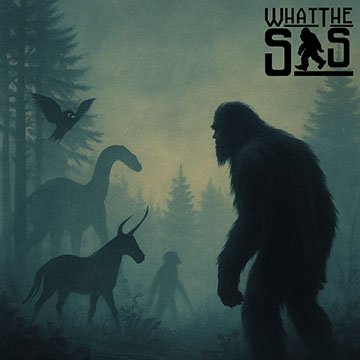
The Spiritual Side of Cryptozoology
The world of cryptozoology is most often framed as a scientific pursuit. Researchers search for physical evidence, analyze footprints, review trail camera footage, and document eyewitness accounts. Discussions usually center around biology, undiscovered species, and environmental adaptation. But beneath the surface of cryptozoology lies another dimension that has existed far longer than modern science—the spiritual dimension. Long before cryptids were classified as unexplained animals, they were understood as spiritual beings, guardians, warnings, messengers, or manifestations of deeper forces connecting humanity to the natural world.
This spiritual interpretation of cryptids spans cultures, continents, and thousands of years of human history. Ancient civilizations, Indigenous nations, shamans, mystics, and storytellers did not separate the physical from the spiritual the way modern society often does. To them, the supernatural was not a category set apart from nature—it was woven into the fabric of everyday life. Cryptid creatures were not curiosities to be proven or disproven. They were part of the living spiritual ecosystem.
Today, many cryptid encounters still contain elements that go beyond physical explanation: vanishing beings, telepathic impressions, time distortions, synchronicities, recurring dreams, and overwhelming emotional or energetic sensations. These experiences suggest that cryptozoology may not simply be the study of unknown animals, but also a doorway into humanity’s oldest spiritual understandings of the world.
For as long as humans have walked the earth, we have told stories about beings that live at the edges of our perception. These beings guard mountains, rivers, forests, caves, and sky paths. They appear in moments of danger, transformation, or deep imbalance. In Indigenous cultures across North America, Sasquatch is not merely a physical creature; he is often viewed as a forest spirit, protector, or elder being. In Tibetan traditions, the Yeti is sometimes considered a guardian of sacred mountains. In Africa, water spirits and river beings are spoken of with reverence. In Ireland, the Sidhe are not fairytales but powerful entities occupying another layer of reality.
These traditions all share a common worldview: the physical world and the spiritual world overlap.
This overlap forms the foundation of the spiritual side of cryptozoology.
One of the most consistent spiritual elements in cryptid encounters is the sense of presence. People do not simply see a creature—they feel watched, guided, warned, or called. Many Bigfoot witnesses describe receiving an overwhelming sense of awareness before the creature appears. Some speak of deep fear, while others feel peace or awe. This emotional and energetic component suggests something more than a random wildlife sighting.
In paranormal research, this is often referred to as an “experiencer event”—an encounter that changes a person’s perception of reality. These experiences may include:
• intense emotional shifts
• vivid dreams following encounters
• telepathic sensations
• missing time
• sudden spiritual awakenings
• a lifelong sense of connection to nature
These are not the typical outcomes of witnessing an undiscovered animal. They are more consistent with spiritual or consciousness-based encounters.
Another spiritual element of cryptozoology is liminality. Cryptids often appear at thresholds: forest edges, riverbanks, mountain passes, cave mouths, swamps, borders between wilderness and civilization, and twilight hours between night and day. Spirit beings in folklore appear in these same spaces. The idea of “thin places,” where the veil between worlds grows fragile, appears in cultures across the globe.
Many cryptid sightings take place:
• at dusk or dawn
• during fog or mist
• during storms
• near sacred sites
• at moments of emotional stress
• at points of personal transformation
In spiritual belief systems, these are precisely the moments when the boundary between dimensions weakens.
Sasquatch is one of the most powerful examples of cryptozoology’s spiritual side. In many Native traditions, Sasquatch is not hunted. He is respected. He is referred to as “the elder brother,” “the watcher,” or “the forest people.” He is believed to walk between worlds, appearing when necessary and vanishing when no longer needed.
Many Indigenous stories describe Sasquatch as a being that:
• protects nature
• warns humans of environmental imbalance
• punishes disrespect for the land
• teaches lost travelers
• guides hunters
• guards sacred spaces
These are not animal behaviors. These are spiritual roles.
Some modern witnesses describe Sasquatch not as aggressive, but as purposeful. They sense intelligence that feels ancient, patient, and deliberate. Some witnesses report feeling as though the encounter carried a lesson or message rather than a threat.
The spiritual side of cryptozoology also appears strongly in flying cryptids like Mothman, Thunderbirds, and winged beings. Mothman sightings in the 1960s were linked to disaster and prophetic warning. Thunderbird legends across Native cultures describe enormous birds with control over storms, lightning, and sky power. These beings are not interpreted as mere birds—they are sky spirits.
Modern Mothman encounters frequently include:
• prophetic dreams
• feelings of dread before disasters
• repeated synchronicities
• spiritual symbolism
• psychological and emotional disturbances
This aligns Mothman closer to an omen or spiritual messenger than to a zoological anomaly.
Water cryptids also carry powerful spiritual meanings. From Lake Champlain’s Champ to the Great Lakes’ Mishipeshu to river serpents and sea beasts found in every maritime culture, water creatures almost always represent transformation, danger, and the unknown depths of consciousness.
Water in spiritual belief systems symbolizes:
• the unconscious mind
• transformation
• birth and death
• emotional power
• the underworld
• spiritual initiation
This explains why water cryptids feel more mythic than biological. They are not simply animals hiding in lakes. They are guardians of spiritual thresholds.
The Little People—reported across Indigenous cultures as small humanoid beings—represent another bridge between cryptid research and spiritual folklore. These beings are often described as playful, mischievous, protective, or dangerous depending on human behavior. They appear, disappear, guide lost people, and punish those who disrespect sacred spaces.
Modern sightings of small humanoid cryptids often contain:
• teleport-like movement
• vanishing instantly
• shadow-like forms
• trickster behavior
• protective actions
These behaviors match spiritual trickster archetypes rather than biological organisms.
Another major spiritual element in cryptozoology is shape-shifting. Many legends describe beings that can change form at will. This appears in skinwalker traditions, water spirits becoming animals, Thunderbird becoming human, forest guardians shifting between animal and humanoid forms. Shape-shifting reflects one of the oldest spiritual concepts: that identity is fluid, and form is merely an expression of energy or consciousness.
Modern witnesses occasionally report cryptids that:
• blur or distort in appearance
• appear partially solid
• change size
• become shadow-like
• vanish abruptly
These traits defy traditional biological explanation but align strongly with spiritual or interdimensional theories.
Cryptozoology also intersects with spiritual belief through sacred geography. Certain areas repeatedly generate cryptid activity. These locations often overlap with ancient ceremonial grounds, burial mounds, ley lines, energy vortexes, or spiritually charged landscapes.
Examples include:
• Appalachian Mountains
• Pacific Northwest forests
• Great Lakes region
• Southwestern deserts
• Hawaiian volcanic sites
• Irish coastal cliffs
These places have long been considered spiritually active zones. Cryptid activity may be another expression of those unseen forces.
Modern cryptid researchers often approach their investigations with skepticism, but many quietly admit that pure physical evidence alone does not fully explain what witnesses report. Footprints and photographs account for only part of the phenomenon. The emotional impact, synchronicities, spiritual awakenings, and recurring encounters suggest something deeper may be happening.
Some researchers now explore theories that cryptids may exist at the intersection of:
• biology
• consciousness
• dimensional physics
• spiritual realms
• collective human perception
This does not dismiss physical evidence—it expands the framework through which that evidence is interpreted.
One of the strongest arguments for the spiritual side of cryptozoology comes from the consistency of these themes across cultures that never communicated with one another. The same archetypes appear globally:
• giant forest guardians
• flying sky omens
• lake monsters
• trickster beings
• shape-shifters
• shadow entities
These universal symbols suggest that cryptids may represent a shared human interface with unseen dimensions rather than isolated zoological mysteries.
Many modern experiencers report that after a cryptid encounter, their spiritual worldview changes dramatically. They feel more connected to nature. They develop intuitive awareness. They question reality itself. This transformation mirrors the traditional initiation experiences found in shamanic cultures.
In shamanism, encounters with spirit beings often mark the beginning of spiritual awakening. The parallels between these ancient traditions and modern cryptid encounters are striking.
The spiritual side of cryptozoology does not invalidate scientific research. Instead, it suggests that cryptids may belong to a category of existence that science has not yet fully defined. Just as gravity and electricity existed before humans could measure them, cryptids may exist within dimensions we do not yet understand.
Cryptozoology, at its deepest level, may be less about proving monsters and more about rediscovering humanity’s ancient relationship with mystery.
Ultimately, the spiritual side of cryptozoology asks a different question than most researchers pursue. Instead of asking, “What creature is this?” it asks:
What does this encounter mean?
Why does it happen at this moment?
What is the relationship between humans and the unseen world?
What role does consciousness play in reality?
And what happens when the veil between worlds grows thin?
These questions have guided humanity’s spiritual journey for thousands of years.
Cryptozoology is far more than the search for unknown animals. At its core, it is the modern expression of an ancient relationship between humanity and the unseen. Long before trail cameras and DNA analysis, people encountered cryptids as spiritual forces, guardians of sacred landscapes, and messengers between worlds.
Whether Bigfoot, Thunderbird, lake serpents, Little People, or shadow beings, cryptids continue to appear at the crossroads of fear, wonder, transformation, and belief. They challenge humanity’s understanding of reality and invite us to question what lies beyond the visible world.
The spiritual side of cryptozoology may not offer easy answers—but it offers something far more powerful: a reminder that mystery still exists, that the universe is layered, and that humanity may not be as alone in this world as we once believed.