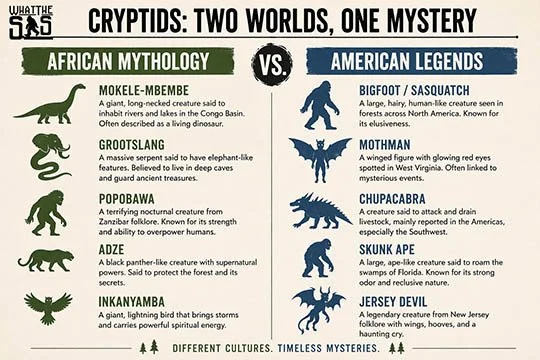
Two Continents, One Mystery
Across the world, stories of mysterious creatures—cryptids, mythical beings, and unexplained phenomena—have existed long before modern science tried to explain them. From the dense jungles of Central Africa to the towering forests of the Pacific Northwest, humans have always shared one thing:
The belief that something unknown lives just beyond the edge of sight.
In North America, Bigfoot, Sasquatch, and other cryptids dominate modern folklore and cryptozoology conversations. Meanwhile, African mythology holds its own powerful collection of mysterious creatures—beings that are often older, deeply spiritual, and tied to the land in ways that go beyond physical explanation.
So what happens when we compare them?
Are these stories completely separate…
Or are they connected by something deeper—shared human experience, environment, and imagination?
Let’s explore the fascinating world of African cryptids vs. American legends, and what they reveal about our understanding of the unknown.
What Defines a Cryptid?
Before diving into specific creatures, it’s important to understand what we mean by cryptid.
In cryptozoology, a cryptid is:
A creature whose existence is suggested but not scientifically proven
Often supported by eyewitness accounts, folklore, or unexplained evidence
Connected to mystery, legend, and cultural storytelling
Examples include:
Bigfoot / Sasquatch
The Loch Ness Monster
The Chupacabra
Various regional creatures across Africa
But here’s where things get interesting:
In African mythology, many “cryptids” are not just animals—they are often spiritual beings, guardians, or forces of nature.
American Cryptids: The Rise of Bigfoot and Modern Legends
Bigfoot / Sasquatch: The Face of Cryptozoology
When people think of cryptids in the United States, one creature dominates:
Bigfoot.
Also known as Sasquatch, this large, hairy, human-like creature has been reported in:
The Pacific Northwest
Appalachian forests
Northern California
Parts of the Southern United States
Common Traits of American Cryptids
American cryptids often share:
A semi-biological explanation
Physical descriptions (height, hair, footprints)
A focus on evidence like tracks, sounds, or sightings
Bigfoot, for example, is often described as:
7–10 feet tall
Covered in dark hair
Walking upright like a human
Highly elusive and intelligent
Other American Cryptids
Beyond Sasquatch, the United States has a wide range of mysterious creatures:
The Mothman (Appalachian region)
The Chupacabra (Southwest and Latin-influenced areas)
The Skunk Ape (Florida swamps)
The Jersey Devil (Northeast folklore)
These creatures are often tied to:
Urban legends
Paranormal events
Specific geographic regions
African Cryptids: Where Myth and Spirit Intertwine
Now let’s shift to Africa—where the concept of cryptids takes on a much deeper and often more spiritual meaning.
The Mokele-Mbembe: Africa’s “Living Dinosaur”
One of the most famous African cryptids is the Mokele-Mbembe, said to inhabit the Congo Basin.
Descriptions include:
A massive, long-necked creature
Semi-aquatic behavior
Dinosaur-like appearance
This creature has fascinated cryptozoologists for decades, with some believing it could be a surviving prehistoric species.
The Grootslang: The Ancient Hybrid Beast
From South African legend comes the Grootslang, a massive creature said to be:
Part elephant
Part serpent
It is believed to live in deep caves and guard hidden treasure.
Unlike American cryptids, the Grootslang is often described as:
Ancient, powerful, and nearly supernatural
The Popobawa: A Creature of Fear
In East African folklore, particularly in Zanzibar, the Popobawa is a terrifying entity.
Unlike Bigfoot, which is often seen as shy or elusive, the Popobawa is:
Aggressive
Supernatural
Associated with fear and night attacks
This highlights a key difference between African and American cryptids:
African creatures are often tied to spiritual warnings or moral lessons, not just mystery.
Key Differences: African vs. American Cryptids
1. Physical vs. Spiritual
American cryptids:
Often treated as undiscovered animals
Studied through evidence and research
Focused on biology
African cryptids:
Often seen as spiritual or mythological beings
Connected to cultural beliefs and traditions
Represent forces beyond the physical world
2. Purpose of the Legend
In American folklore:
Cryptids spark curiosity and exploration
They represent the unknown wilderness
In African mythology:
Creatures often serve as warnings
They enforce cultural values
They explain spiritual or moral concepts
3. Relationship with Humans
Bigfoot and Sasquatch:
Avoid humans
Rarely interact directly
African creatures:
Often interact with humans
Can protect, punish, or guide
Surprising Similarities Across Continents
Despite these differences, there are fascinating overlaps.
Shared Themes
Across both regions, cryptid stories often include:
Large, powerful beings
Remote, hard-to-reach habitats
Elusive behavior
A mix of fear and fascination
The “Wild Man” Archetype
One of the most interesting parallels is the idea of the wild man:
Bigfoot in North America
Similar forest-dwelling beings in African folklore
These creatures often represent:
The untamed wilderness
A connection to nature
Something human—but not fully human
Environmental Influence
Both African and American cryptids are shaped by their environments:
Dense forests create mystery
Limited visibility fuels imagination
Isolation allows stories to grow
Cryptozoology vs. Mythology: A Cultural Divide
In the United States, cryptids are often approached scientifically:
Field research
Footprint analysis
Audio recordings
In Africa, the approach is different:
Oral tradition
Cultural storytelling
Spiritual interpretation
Neither is “more correct”—they simply reflect different ways of understanding the unknown.
Modern Interest: Why These Stories Still Matter
Today, interest in cryptids is growing worldwide.
From:
Bigfoot documentaries
Cryptozoology research groups
Paranormal podcasts
Cultural storytelling revival
People are more fascinated than ever by mysterious creatures.
What These Legends Reveal About Us
At their core, cryptid stories—whether African or American—tell us something important:
Humans are drawn to mystery.
We want to believe that:
The world isn’t fully explored
Something extraordinary still exists
There are stories yet to be discovered
Different Stories, Same Wonder
Cryptids in African mythology and American legends may differ in:
Tone
Purpose
Interpretation
But they share something powerful:
The ability to make us wonder.
Whether it’s Sasquatch moving through the Pacific Northwest or ancient creatures guarding African landscapes, these stories remind us that mystery is still alive.
And maybe…
That’s exactly how it’s supposed to be.