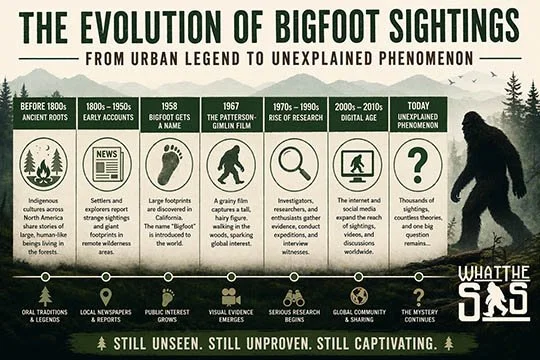
The Evolution of Bigfoot Sightings: From Urban Legend to Unexplained Phenomenon
From Campfire Stories to Modern Mystery
There was a time when stories of a giant, hairy creature lurking in the woods were dismissed as nothing more than folklore—tales told around campfires, whispered through generations, and filed neatly under urban legends. Bigfoot, also known as Sasquatch, lived comfortably in the realm of myth, alongside other mysterious creatures and unexplained phenomena.
But something changed.
Over the decades, Bigfoot sightings transformed from simple storytelling into a growing body of eyewitness accounts, alleged evidence, and ongoing cryptozoology research. Today, Sasquatch is no longer just a mythical creature—it’s one of the most discussed and debated cryptids in the world.
So how did we get here?
How did Bigfoot evolve from legend to something that sits in that uncomfortable space between fiction and possibility?
Let’s take a journey through time, geography, culture, and science to explore the evolution of Bigfoot sightings.
Ancient Roots: Before “Bigfoot” Had a Name
Long before the word “Bigfoot” ever existed, Indigenous cultures across North America told stories of large, human-like creatures living deep within the forests.
These weren’t casual tales.
They were:
Deeply respected traditions
Passed down through oral history
Often tied to spiritual beliefs
Sasquatch in Indigenous Folklore
Different tribes had different names and interpretations, but many described beings that:
Walked upright
Were covered in hair
Lived in remote wilderness
Avoided humans but observed them
In many traditions, Sasquatch wasn’t just an animal—it was:
A guardian of the forest
A being connected to the spirit world
Something to be respected, not hunted
This is important, because it shows that Bigfoot wasn’t originally viewed as an “urban legend” at all—it was part of a lived cultural reality.
The Birth of the Modern Bigfoot Legend (1800s–1950s)
As settlers expanded westward, they brought with them their own interpretations of the unknown.
Early Reports
Newspapers in the 1800s occasionally reported:
“Wild men” sightings
Large footprints in remote areas
Strange encounters in the wilderness
These reports were often treated as curiosities rather than serious investigations.
The 1958 Breakthrough: Bigfoot Gets a Name
Everything changed in 1958 in Northern California.
A construction crew discovered large footprints near Bluff Creek.
Local media picked up the story…
And the name “Bigfoot” was born.
From that moment on:
Sightings increased
Public interest exploded
Bigfoot became a household name
The Patterson-Gimlin Film: Turning Point in Cryptozoology
In 1967, something happened that would change Bigfoot research forever.
The Famous Footage
Roger Patterson and Bob Gimlin filmed what they claimed was a Sasquatch walking through the forest.
The footage showed:
A large, upright, hair-covered figure
Natural walking movement
A brief but clear visual encounter
Why It Matters
To this day, the Patterson-Gimlin film remains:
One of the most analyzed pieces of cryptid evidence
A cornerstone of Bigfoot research
A major reason the phenomenon persists
Whether real or not, it pushed Bigfoot out of folklore and into global discussion.
The Rise of Bigfoot Research (1970s–1990s)
Following the film, Bigfoot sightings surged.
What Changed
More people entered the wilderness
Media coverage increased
Interest in paranormal and unexplained phenomena grew
The Birth of Cryptozoology
Bigfoot became a central focus in the field of cryptozoology, which studies animals not yet proven by science.
Researchers began:
Casting footprints
Recording sounds
Interviewing witnesses
For the first time, Bigfoot was being studied—not just talked about.
The Internet Era: Bigfoot Goes Global
The early 2000s brought a new wave of Bigfoot sightings and research.
Digital Expansion
With the rise of the internet:
Eyewitness accounts spread faster
Videos and photos became easier to share
Online communities formed around Sasquatch research
Bigfoot was no longer just a regional legend—it became a global phenomenon.
Social Media and Modern Sightings
Today, platforms allow:
Instant sharing of encounters
Real-time discussion
Worldwide participation
This has led to:
Increased reporting
Greater scrutiny
More skepticism—but also more curiosity
Patterns in Bigfoot Sightings
Despite the passage of time, certain patterns remain consistent.
Common Elements
Most Sasquatch encounters include:
Remote forest environments
Brief visual sightings
A strong emotional reaction from witnesses
Lack of physical evidence afterward
These similarities across decades and locations are one reason the mystery endures.
Urban Legend vs. Unexplained Phenomenon
So where does Bigfoot sit today?
Urban Legend Perspective
Some believe Bigfoot is:
A product of folklore
A misidentification of known animals
A cultural myth that evolved over time
Unexplained Phenomenon Perspective
Others argue:
The consistency of sightings is too strong
The volume of reports is too high
Some evidence defies easy explanation
This puts Bigfoot in a unique category:
Not proven
Not disproven
Still unexplained
The Role of Environment in Bigfoot Sightings
Bigfoot sightings are most common in:
The Pacific Northwest
Appalachian forests
Remote wilderness areas
These environments share:
Dense vegetation
Limited visibility
Low human presence
Perfect conditions for:
Hidden wildlife
Misinterpretation
Or… something unknown
Scientific Skepticism and Ongoing Debate
The scientific community remains largely skeptical.
Main Arguments Against Bigfoot
No confirmed biological evidence
No bones or remains
No verified DNA
But at the same time…
Questions That Remain
Why do sightings persist?
Why are descriptions so consistent?
Why do some encounters defy explanation?
Bigfoot in Pop Culture
Bigfoot has become more than just a cryptid—it’s a cultural icon.
From:
Movies and documentaries
TV shows and podcasts
Merchandise and storytelling
Bigfoot has moved into mainstream awareness while still maintaining its mystery.
The Psychology of Belief
Why do people believe in Bigfoot?
Because it represents:
The unknown
The unexplored
The possibility that something still exists beyond our understanding
In a world where most things are explained…
Bigfoot remains a question mark.
Where Bigfoot Stands Today
Today, Bigfoot exists in a unique space:
Part folklore
Part research subject
Part cultural phenomenon
It has evolved from:
Campfire story
Newspaper curiosity
Scientific curiosity
Global mystery
A Legend That Refuses to Disappear
Bigfoot sightings have come a long way.
From ancient folklore to modern cryptozoology, from urban legend to unexplained phenomenon, the story of Sasquatch continues to evolve.
And maybe that’s the point.
Bigfoot isn’t just about proving something exists.
It’s about reminding us that mystery still lives in the world.
That there are still forests we don’t fully understand.
And that sometimes…
The most powerful stories are the ones we can’t quite explain.